
Giovanni Gentile

Giovanni Gentile (AD 1875–1944) was one of modern Italy’s most formidable philosophers, educators, and political theorists. A leading figure in the revival of Italian idealism alongside Benedetto Croce, Gentile developed the system of “actual idealism” (attualismo in Italian), arguing that reality exists only in the pure, self-creating act of thought. He reshaped Italian public life both as Minister of Public Instruction, where he overhauled the nation’s educational system, and as director of the monumental Enciclopedia Italiana. In 1944, he was assassinated by communist partisans in Florence.

Widely known as the “philosopher of Fascism,” Gentile provided the Italian Fascist movement with its most rigorous theoretical and ethical foundations, serving as the primary ghostwriter of Benito Mussolini’s doctrinal statements. In What is Fascism: Discourses and Polemics, he situates Fascism within the broader arc of modern Italian history and elaborates his conception of the Fascist State with respect to the nation, ethics, culture, religion, liberalism, and constitutional reforms.

He did philosophically for Italian Fascism what Sergio Panunzio did juridically.

Books in English Translation

What is Fascism: Discourses and Polemics (Italian Politics, Politics, Fascism)
Featured Title

What is Fascism: Discourses and Polemics by Giovanni Gentile

What is Fascism: Discourses and Polemics

By Giovanni Gentile

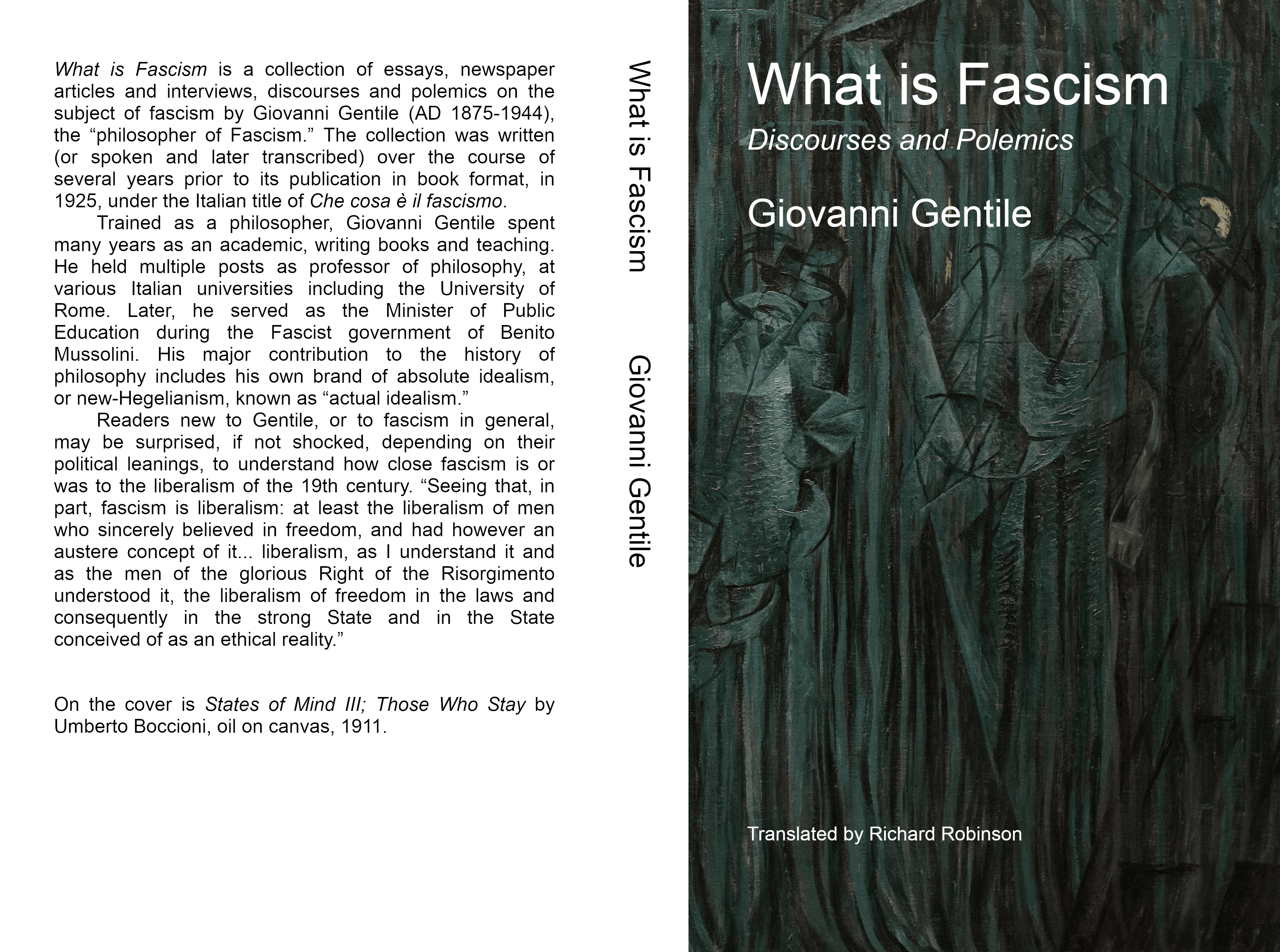
What is Fascism is a collection of essays, newspaper articles and interviews, discourses and polemics on the subject of fascism by Giovanni Gentile (AD 1875-1944), the “philosopher of Fascism.” The collection was written (or spoken and later transcribed) over the course of several years prior to its publication in book format, in 1925, under the Italian title of Che cosa è il fascismo.

Trained as a philosopher, Giovanni Gentile spent many years as an academic, writing books and teaching. He held multiple posts as professor of philosophy, at various Italian universities including the University of Rome. Later, he served as the Minister of Public Education during the Fascist government of Benito Mussolini. His major contribution to the history of philosophy includes his own brand of absolute idealism, or new-Hegelianism, known as “actual idealism.”

Readers new to Gentile, or to fascism in general, may be surprised, if not shocked, depending on their political leanings, to understand how close fascism is or was to the liberalism of the 19th century. “Seeing that, in part, fascism is liberalism: at least the liberalism of men who sincerely believed in freedom, and had however an austere concept of it... liberalism, as I understand it and as the men of the glorious Right of the Risorgimento understood it, the liberalism of freedom in the laws and consequently in the strong State and in the State conceived of as an ethical reality.”

View on Amazon